
#7 You are only as good as your weakest link
Last but not least, this old sporting adage. We all need to be strong in the team to get the win. Any chink in our armour, and the opposition will capitalise.

This quote from David Jeter, American baseballer, made me think however, about how we are potentially defining weak links that may exist in our team.
Is the weakness through a lack of talent or through a lack of work ethic? Does that lack of work ethic arise because they aren’t as engaged as they could be? Are they in the wrong role? Or perhaps in the right role, but with too much emphasis on things that they are weaker at? Where as their leader can you help to adjust their role so they are really able to play to their strengths, and contribute more fully to the success of the team?
Also as leaders, perhaps sometimes we are the weaker links in certain areas. Do you support and encourage those members of your team who complement your areas of weakness with their strengths? How do you acknowledge their work when they support you?
If your attempts with the so called ‘weak link’ haven’t worked, is building a team culture of performance enough for the weak link to self-identify and move on? Where necessary can you discuss with the team member what path may be better for them?
Although identifying your weakest link may seem quite simple, it may be the case that the reasons behind this weakness aren’t as simple as we first thought.
Thank you for reading my 7 coaching lessons from the world of sport – would you agree with them? Please let me know if you think there are any other particularly pertinent lessons from sport that I haven’t mentioned.
And just a final comment: a famous snooker commentator Ted Lowe once said “That was inches away from being millimetre perfect”. In life and as leaders we’re often going to be inches away from getting it right rather than millimetres, but by reflecting on lessons such as these seven and consistently seeking to improve, we can only strive to get better!

#6 Get the basics right
So another quote from one of our American friends, a legend on the basketball court Michael Jordan:

and also from an ex-Australian cricket captain, Steve Waugh:

We often have to think about the next big project, the next big win, the next big innovation. But do we have the basics down to get there successfully? Are we worrying about the pretty and not about knocking off the single runs?
Teams who don’t feel they have the fundamental building blocks right will stumble when trying to move higher.
I just wanted to highlight 3 key points that I think, if we get right with our teams, we’ll be making leaps and bounds:
- Problem solving – are we too quick to jump to the solution and solve the wrong problem? Do you have a method as a team for getting to the root of problems to plan the best course of action? Do you contact your peers in the group to see if they already have a tried and tested answer?
- Structured Meetings – How many meetings do you attend without any clear agenda? Do you stick to timings when you call a meeting? Are you conversations efficient or do they regularly run away on tangents? Do you come prepared to meetings with your team? How often do you send clear minutes and follow up on action items?
- Valuing your team’s time – Are you there when you say you’ll be there? When you’re in the room, are you in the room? Do you stay until the end of meetings? If not, do the team understand fully why? Do you follow up if necessary? Do you make sure you know when and where your team is going to be and encourage two way accommodation of diaries and priorities?
In life, it’s all about getting the basics right too. For example, whatever happens, make sure you are always wearing the right shoes for the occasion.
#5 Lead by example
So this is a bit of a given, but it had to be in there somewhere.
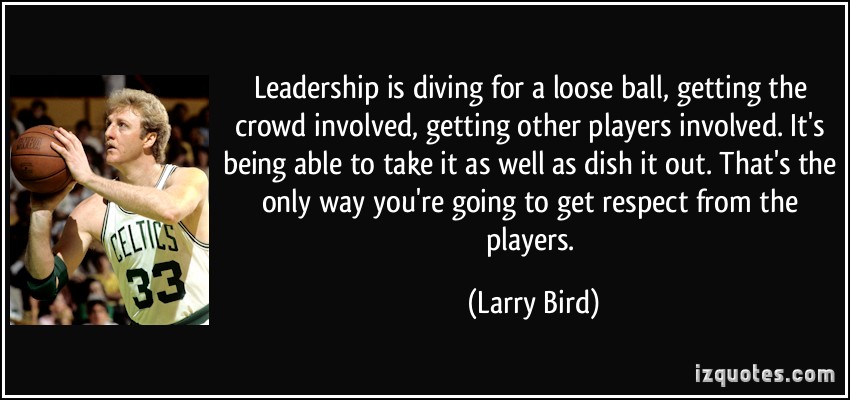
Larry Bird – originally a basketballer for the Boston Celtics, and then after retiring he became the NBA All Star Game Coach and also the NBA Coach of the Year in 1998.
I think it is no surprise to anyone the difference a leader can make with their behaviours, and how powerful it can be for the leader to still get their hands dirty from time to time, dive for that loose ball. We’ve all experienced as followers and members of a team how a leader can drive behaviour in a positive way or a negative way depending on their approach and demeanour.
Can we take it as well as dish it out? Linked to lesson #2 “Make everyone feel part of the same team”, it is important to really think about whether we are involving everyone, including ourselves, in the team activity.
Do we take on the responsibility for our team and their behaviour especially at critical times? Sharing the losses as well as the wins.
I read an interesting article about the fact that one of Ricky Ponting’s driving mantras is ‘Lead by example’. His stats showed that overall he actually batted even better when he was captaining. In 2005 Australia lost the Ashes, and Ponting has acknowledged that he took the responsibility for that loss as the team’s captain. He also then took on the responsibility to captain his team through to win at the next Ashes encounter, and not only that but to deliver a 5-0 whitewash.
He also made another specific comment which stood out to me “Good leaders know they can lead, they don’t just think they can.” Without being delusional, if we’re really going to lead successfully by example, do we need to back ourselves more?
#4 Do not dwell on mistakes, do not point fingers

What happens when you dwell on an error on the football pitch? When you dwell on a teammate’s error?
You become distracted right? How often do you see a team score a goal and follow it up quickly with another one, because the opposing team hasn’t been able to move on from the mistake?
I’m in Organisational Development, so it’s a bit of a cliché me saying this, but how often do we focus on the learning that we can gain from a mistake, rather than just the mistake?
We all know how hard it is to deal with a mistake when it impacts a project or a team greatly, but we also all know how the majority of people won’t be let that mistake happen again. Repeated mistakes or behaviour are indeed a problem to be addressed, but not letting go of a team member’s mistake after it has happened is equally a problem.
So let’s think… how well do you let people come back from their mistakes? How do we support others in getting over their possible guilt and embarrassment to come back stronger?
An example from the sporting world for me, is David Beckham’s sending off in the 1998 World Cup against Argentina. During the second round match of the championship, Beckham was fouled by the Argentinian captain and went down. Then, seeing red, he retaliated, kicking the shin of the opposing player before getting up off the floor. The Argentinian player went down like he had been shot of course (and has subsequently admitted to overacting) however the deed occurred right in front of the referee and Beckham received a red card.
After being such a star at Man United, contributing so much to England’s qualifying for this World Cup and grafting on the pitch in the group stage, this one mistake turned the entire nation against him. England were eventually knocked out on penalties, but no one really remembers Batty missing his penalty to put us out. Rather everyone’s attention was directed towards that heinous villain David Beckham, with the petulant temper, the annoying Spice Girl wife and the fact that he, of course, lost us the entire World Cup (not just that second round match).
The press were ruthless, with The Sun tabloid printing his face on dartboards for people to cut out of the paper and people around the country making David Beckham effigies to be hanged or stabbed with pins.

This could have been the end for Beckham, and yet he worked his way back into the nation’s psyche as a national treasure, champion of the 2012 London Olympics and even had his ‘right’ and ‘left’ foot mentioned in the cinematic masterpiece “Love Actually”, when Prime Minister Hugh Grant is waxing lyrical about the strength of the British nation.
Strength of character indeed to come back from the public bashing he received and the cold shoulder from his teammates in the changing room afterwards. In his autobiography however, he makes one key comment about an act that really helped him immediately after the end of the match. His captain, Tony Adams, big Arsenal defender, walked over to him in the changing room in and, in front of all the other team members, put his arm around him, gave him a strong squeeze and said ‘Look son, everyone makes mistakes, don’t let it get you down. You are going to come back stronger and better.
Who knows, perhaps Beckham would still have come back and captained his country, still become the nation’s darling and taken elocution lessons, even without Adams’s small gesture. Then again, perhaps not. Adams, as his captain, gave him a small nod that it was ok to have made that mistake.
#3 Trust your team
So trust, it had to come up. So let’s think about this quote from Richie Benaud (one of the best, most impartial and knowledgeable commentators out there, in cricket, but also across the board):
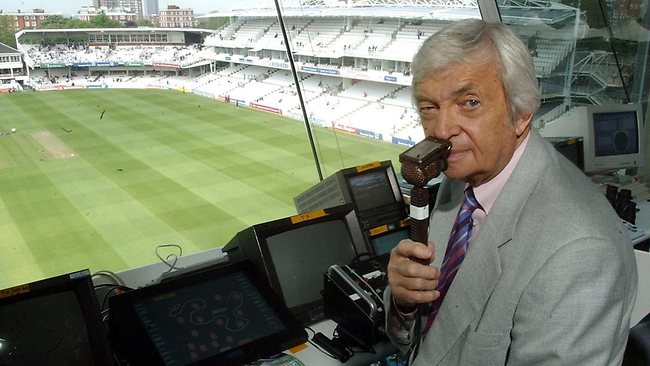
“My mantra is: put your brain into gear and if you can add to what’s on screen then do it, otherwise shut up.”
There’s nothing worse than a commentator who talks too much. Telling the spectator what he already knows from the visual. Adding noise without adding anything beneficial. Richie trusts the pictures to do the job, and supports the pictures with impartial words when required.
As a leader of your team, do you trust your team to do their job? Where do you let the team have the responsibility and authority for their actions? Do you let the pictures play out when they’ve ‘got it’? Even if perhaps you’d do it differently yourself. Do you keep comments to yourself when they’re really not needed?
And if we trust in our team, we’re perhaps en route to breeding a general culture of trust. Have you noticed that high performing teams don’t ever really talk about trust? It’s just there.
On the rugby pitch, we see the most fluid play when the trust is there. Thinking about the off side rule, you can’t block or shield a player like in American Football, as you have to remain behind the ball. So what do you do? You support your teammate and ‘be with them’.
You see rugby players running really hard, ‘just’ to support and be there alongside the bloke with the ball. And that bloke with the ball trusts that they will be there, trusts that when he needs to pass, his teammate will be there in the right place. He’s just ‘doing his job’ – quite. But can we trust he will do his job – as he said he would, when he said he would, according to the plan.
So do our behaviours mirror that which is expected? Do we offer behavioural predictability? Simply, does your team know how you will react? Can it trust in your behaviour? Win or lose, can they predict your response? Are you consistent in your message?
Are you there from the start to the end? Are you there when you say you will be?
One video on sports coaching that I watched recently talked about the ‘trust account’ and noted that each action you perform which shows a predictable, consistent approach banks you some trust in your account. You can build that account, but unlike money, where every dollar is equal, not all actions in the workplace or on the sporting pitch have the same trust value. As leaders with our team and indeed with those around us in life, we need to remember that it is highly possible to completely blow and erode our trust account with one action.
Be predictable. Be consistent. Breed trust.
#2 Make everyone feel part of the same team. No cliques, no favourites, no inner circles.
Are there cliques in your team? Are you guilty of favouritism?

The picture here is of the Colombian 2014 World Cup team, who demonstrated, for me, one of the clearest examples of a team coming together to achieve together.
A clear star here was James Rodriguez who won the Golden Boot this year; yet the culture in the Colombian team wasn’t that of stars and egos.
When James scored against Nigeria and ran to the corner to celebrate, he waited for his team mates to come and dance with him. Furthermore, on looking up to the bench and seeing the substitutes celebrating, they all ran down the touchline to form an even bigger dance troop – shown in the picture here.
When James scored his second goal against Uruguay thanks to a fantastic flick header from Cuadrado, he didn’t run to celebrate and take the glory. He acknowledged that it was more about the set up than his finish, and if you watch the footage of James after the goal, you see him point quite specifically at his teammate, seemingly suggesting it was as much Cuadrado’s goal as Rodriguez’s.
This lesson also makes me think about another favourite sporting event, the Ryder Cup. I mention this specifically here as I remember a conversation I had with my dad when I was very young about the European and US teams. I remember my dad talking about the 13th man, which at the time I didn’t really understand as there are only 12 players on a Ryder Cup team. He explained to me that on the US tour, players don’t mix, they are individuals, focused on the tournament and the round they have to play that day – I distinctly remember him saying ‘Al, they won’t even have breakfast with one another if they’re in the same hotel’. In contrast, on the European tour, players got on well, joked together on the course, and, well, probably ate breakfast together.
The US players are strong, outstanding individuals. When it comes to the Ryder Cup though, in recent times they have struggled when playing as a team – the European team coming together far more naturally, as one group, and so as a result, they had the benefit of the 13th man. The team itself.
So let’s think about your teams. We all know there are ‘stars’ or ‘hi-pos’ as they called in the corporate world. Does the star team member get cut a break? How do we level out the team to maximise the strength of everyone?
Also, we know, not everyone is going to be the first batsman, nor your top striker. But we will always struggle without a strong middle order, without someone to set up that striker. I remember Usain Bolt’s anchor leg in the recent Commonwealth Games – I have to admit I don’t remember who ran the 2nd leg. I have no doubt however that the Jamaican relay team coach knew the ins and outs of his 2nd leg athlete just as well as his anchor leg.
Do you know your middle order well? Do you spend time with them as well as your strongest and weakest? The middle 70% are often going to be the ones perhaps low in confidence because they’re well aware they don’t have the sparkle of the hi-potentials, or under supported because they don’t cause you the problems of your weaker team members.
How are we involving everyone and forming that team mentality? Do you stop the egos from taking over, including your own? Interesting to think about whether this is something that happens naturally for you as a leader, or if it’s something that you actively have to make happen. Either way, I think we all see the benefits that can be reaped.
As a closing point, James Rodriguez has been signed to Real Madrid after the World Cup. Will he come back to the Colombian team with the same all-inclusive mentality in 2018? In my opinion, this will depends heavily on how he is treated by the coach.
Last week as part of the leadership program I am running at work, I delivered a webinar to 20 middle managers which discussed the 7 coaching lessons I believe all leaders should take from the world of sport into the workplace.
I think as team members and team managers, it’s not hard to see the easy analogy between sporting teams and work teams. How a sporting team has to work together on the pitch or court to bring results, often mirrors quite closely how we must work together in the workplace to also achieve success. A key factor in this success is the way in which managers consciously or subconsciously assume the role of coach to motivate, support and lead their team.
I thought I would share my 7 lessons with you over the next 7 weeks, as I believe that, as well as sound lessons for leaders in the workplace, many of them are pertinent for us all generally. So let’s kick off with number 1…
#1 If you don’t have a goal, you don’t have a game
Bill Copeland, an Australian cricketer and subsequently test match umpire, made the following comment:
I suppose goals in sport are easy. As long as we know how to play the game, we’re pretty likely to know what they are – whether we’re talking about a literal goal on the pitch or the ultimate goal of winning the game, championship or medal. As a sports coach and a sports team, we are almost always gunning for the same goal, unless there is real disharmony (let’s leave match fixing aside for the time being!) As a coach in sport you must work to bring that rhythm, coherent play and understanding to the team to reach those goals.
In contrast, as leaders in the workplace (and of course in life in general), we’re in the sticky situation of not always having clear goals handed to us on a plate. Or alternatively, we may not always all have the same goals. Do we know the organisation’s goal? If not, then let’s look at things through a more focused lens, what are my goals as a leader of this particular team, what are the team’s goals, what are the individuals’ goals within that team? Do they align? And the more important question perhaps, can I help make them align?
If members of your team have slightly different ambitions or goals in their roles or career, can you accept those and acknowledge them, while still making a compelling case for the team goal? Can you help those same people understand and support you in achieving the team vision?
On the football pitch, as a team member, even if you might disagree with some of the coach’s specific plays, do you still follow the instructions because you believe in the overall objective?
We all know how important it is to have a guiding strategy and goal for our teams, indeed on the grander scale, a vision that we’re all working towards within an organisation. But if you don’t feel you have that from your senior management team, what else can you do for those looking to you?
Well how about we think about what IS in our control, instead of focusing on what we don’t know and can’t always control. What smaller goals can you set within your team for that month, quarter or year?
Would your team know what basket they were shooting at if I came to ask them? How often do you explain the ‘why’ to your teams as well as the ‘what’?
If we feel that we’re losing control and just blindly running up and down the field, whether leading a team or simply leading a life, it is our responsibility to take the time to have another look at that playbook, refocus the tactics and shoot for the goal we want.
So we’re 18 days from the first kick of the 2014 World Cup. Timmy Cahill had his own section on 60 minutes last night (nice bloke eh?), but otherwise, only a few ripples from the Aussies about the beautiful game and its biggest tournament (not including the McDonald’s adverts and their Brazil burgers). Well, I’m in Sydney and it IS the first Origin game on Wednesday I suppose…
But this lack of interest doesn’t half make me miss home. I remember that buzz in the build up to a big tournament like the World Cup or the Euros. Can easily conjure that feeling of watching England with a group of ever-optimistic English fans, who have known the pain of disappointment far too many times. Wrapped in a St George’s cross, hardly able to bear watching the penalty kicks but not able to look away. Not just a game but a total leveller, where English supporters of all genders, ages and races come together and feel every kick, every fall, every goal, every miss.
Last World Cup in Sydney, I watched, lonely and shivering, every England match (granted there were only 4) in the wee hours of the morning. That time difference, sigh. Thankfully the first match this year is at 8am on a Saturday! Sweet mercy from the football gods. The English are rallying and bacon butties are being promised for half time. You never know – maybe, just maybe, this year really will be our year and it won’t matter that I’m on the other side of the world. I mean come on, everything’s pointing in that direction – Austria won Eurovision in 1966 too…

So yesterday I went to the Festival of Dangerous Ideas at the Sydney Opera House to attend a talk by Hanna Rosin entitled ‘The End of Men’. Dangerous idea indeed.
Rosin discussed the rise of women in the workplace, the increasing number of couples where women are the major breadwinner and young women’s changing views on relationships with men.
For many women, have men become ‘just another mouth to feed’ in a family of dependents? Are young women perfectly happy with the modern ‘hook up culture’ cos ain’t nobody got time for commitment? (As one female college undergrad Rosin interviewed said ‘a boyfriend is equivalent to a 4 unit college subject and I’d prefer to finish my degree more quickly than bother with a guy full time’!) Are we eventually going to end up with a society of dominant women and ball and chain men?

Well as my friend Gold Coast Blonde would say ‘unlike Derby Day, things aren’t always so black and white’. Most women don’t want the ‘end of men’ – c’mon don’t be so dramatic. The difference is women now don’t ‘need’ men to survive in society, and indeed many thrive without. However not needing doesn’t necessarily mean not wanting. And I put it to you boys – isn’t wanting someone much better than simply needing someone? Perhaps it’s now the case that it’s men who don’t want a woman who doesn’t need THEM? Oh I don’t know.
Anyway talking of Derby Day, it’s racing seasons ladies. Let’s celebrate our feminity and get a bit dolled up. Melbourne Cup is about fun fashions and splashes of colour (fashion and feminism don’t have to be mutually exclusive in my humble opinion). But don’t leave the sport of kings to the men – have a look at the form and if you fancy it, have a flutter to make the race a bit more exciting!
As a wannabe stealer of hearts, my pick is Voleuse de Coeurs. But of course, I’ll only be stealing your heart on my terms lads… 😉
The scene was set for a fantastic David and Goliath style victory. The tiny nation of New Zealand taking on the might of the USA in the Americas Cup (hey – they’re so good at this event, it’s named after them) and inexplicably forging an 8-1 lead.
‘Great work Kiwis- game over’ people said. ‘Serves that Aussie right’ the Antipodeans thought of the traitorous Ben Ainslie, Australian captain of the American Crew. The same man who people chuckled and scoffed at in press conferences when he said his team was still in with a shot.
And yet his hunger and determination bore the sweetest fruit – one of, if not THE, greatest comeback in sporting history; grabbing a 9-8 win and deserved global admiration.
The choker/comeback dichotomy and spectacle. As spectators do we actually love the tenacity of the comeback kids or are we revelling in Schadenfreude at the train wreck loss by their opponents? Depends a little bit on if your team is playing or not I guess.
Not long after the excitement of the Americas Cup, I watched the team to which I had recently pledged allegiance fold like origami in the NRL semis. Souths, the Bunnies – with my fellow compatriots the Burgess Boys, the Daddy G.I. and a 42 year winning drought – this was my perfect team! Yet another night at my sporting HQ, The Star, with partner in crime, Gold Coast Blonde, we watched them lose an 8 point lead to go out of the competition and break their own and their fans’ hearts for yet another year. What happened at half time after that amazing spell of defence at the end of the first half? They crumbled, Manly stepped it up and not another point was scored in answer. Russell Crow was not happy. “Are you not entertained?” No. You might have to pop your gladiator sandals on next season love.
So many chokes/comebacks over the years, across so many sports. Greg Norman in the 96 US Masters, Jimmy White in a couple of snooker world finals, Steven Bradbury’s speed skating upset in the Salt Lake Winter Olympics, Roberto Baggio in the 94 World Cup final penalty shootout. I remember them all vividly. Hmm interestingly all sportsMEN that have sprung to mind…
An analogy for the current dating scene I’m experiencing in Sydney? Men who flounder when speaking to women who might have an opinion that differs from theirs? Men who just walk away when they might have to make a bit more effort than a drunken ‘Hi. What’s your name? How old are you? Want to come home with me?’ (a genuine pick up attempt I have experienced – would genuinely be interested in his success rate with that one).
So my question is this – single men on the prowl, when you are chatting up a modern woman of this world and she says something slightly challenging, will you choke and disappear quietly into the night? Or will you hit her with a dazzling comeback that makes her pause for a second, frown slightly, then smile as she thinks ‘this just got interesting’?
Ok lads – let’s start channeling that US America’s Cup team.
 allgamesnorules